 +86 13828069877


From Quartz to Acrylic Solid Surface: Why Kitchen Countertop Materials Are Changing
2026-11-03
1
How silica-related health concerns are reshaping the engineered stone market and creating new opportunities for acrylic solid surface manufacturers.
For many years, quartz countertops have been one of the most popular choices for modern kitchens. Their stone-like appearance, wide range of colors, perceived durability, and relatively low maintenance requirements have made them attractive to homeowners, kitchen manufacturers, designers, and building-material distributors.
However, the countertop industry is evolving. Growing concerns about respirable crystalline silica dust, together with regulatory changes in certain markets, are encouraging fabricators, distributors, and manufacturers to reconsider their material choices.
Against this backdrop, acrylic solid surface is gaining attention as an alternative for kitchen countertops and other interior applications. Its potential advantages include seamless fabrication, thermoforming capabilities, repairability, and the availability of formulations that do not contain crystalline silica.
For buyers looking for new material opportunities, understanding the differences between quartz and acrylic solid surface is increasingly important.
1. Why Did Quartz Become a Popular Kitchen Countertop Material?
Engineered quartz became widely adopted because it offered a practical combination of appearance, performance, and manufacturing consistency.
Stone-Like Appearance
Quartz surfaces can replicate the visual character of natural stone while offering a broad selection of colors and patterns. From subtle neutral shades to dramatic marble-inspired designs, they fit a wide range of kitchen styles.
Hardness and Scratch Resistance
Quartz countertops are generally hard and resistant to everyday scratching. This characteristic makes them attractive for busy kitchens, although their performance still depends on the specific product, surface finish, and conditions of use.
Low Routine Maintenance
Compared with some natural stones, many engineered quartz products do not require periodic sealing. This convenience has helped make quartz a familiar option for residential and commercial countertop projects.
Consistent Production and Design Options
Factory production allows manufacturers to offer repeatable colors, patterns, and slab specifications. For distributors and fabricators, consistency can simplify product selection and project planning.
These advantages explain why quartz became a major countertop material. However, its manufacturing and fabrication processes have also brought an important occupational health issue into focus.
2. Why Are Some Markets Restricting Engineered Quartz Stone?
The key issue is not simply the presence of quartz as a finished kitchen surface. It is the respirable crystalline silica dust that can be generated when certain stone materials are cut, ground, drilled, or polished.
Understanding the Silica Dust Risk
Many engineered quartz products contain high proportions of crystalline silica. When these materials are processed, fine airborne dust can be released. Workers who inhale respirable crystalline silica over time may develop silicosis, a serious and potentially fatal occupational lung disease.
The risk is especially important for countertop fabricators and installers who regularly cut, grind, polish, and modify stone slabs.
Appropriate engineering controls, dust suppression, ventilation, work practices, and respiratory protection are important measures for managing silica exposure. Nevertheless, regulators have concluded that additional restrictions are necessary for certain engineered stone products in some jurisdictions.
Australia: A Major Regulatory Turning Point
Australia introduced a prohibition on the manufacture, supply, processing, and installation of defined engineered stone benchtops, panels, and slabs from 1 July 2024. Restrictions on importing covered products took effect on 1 January 2025.
Importantly, the Australian prohibition is based on a specific legal definition. It does not mean that every material marketed as artificial stone is prohibited. Certain products containing less than 1% crystalline silica, as well as specified porcelain and sintered stone products, fall outside the ban's scope.
These distinctions matter to manufacturers and importers. Product composition, technical documentation, intended use, and the regulations of the destination market must all be considered before a material is selected or imported.
Australia's regulatory changes have also highlighted the importance of identifying alternative countertop materials that can meet project requirements while addressing silica-related concerns.
3. What Materials Can Be Used as Alternatives to Quartz Countertops?
There is no single material that replaces quartz in every application. The right choice depends on appearance, budget, fabrication requirements, maintenance expectations, local regulations, and project specifications.
Common alternatives include:
- Acrylic solid surface: Suitable for seamless-looking countertops, integrated sinks, curved designs, and customized interior applications.
- Porcelain and sintered stone: Offer a mineral-based appearance and specific performance characteristics, but fabrication requirements and silica-related considerations still need to be assessed.
- Natural stone: Provides distinctive natural patterns, with properties varying by stone type.
- Stainless steel: Often used where a hygienic, functional, or commercial-kitchen aesthetic is required.
- Other approved countertop materials: May be suitable depending on local codes, the application, and the project's performance requirements.
Among these options, acrylic solid surface offers a different combination of design flexibility, fabrication methods, and surface maintenance possibilities.
4. Why Is Acrylic Solid Surface an Attractive Alternative?
Acrylic solid surface is a manufactured surface material commonly formulated using acrylic resin, mineral fillers, and pigments. Exact compositions vary by manufacturer and product grade.
Unlike conventional high-silica engineered quartz, acrylic solid surface can be formulated without crystalline silica. For buyers seeking alternatives to silica-rich countertop materials, this can be an important product-selection advantage.
However, the actual composition should always be verified using the manufacturer's technical data, ingredient declarations, and appropriate test documentation. Do not assume that every product sold as solid surface is automatically crystalline-silica-free.
4.1 Seamless Appearance
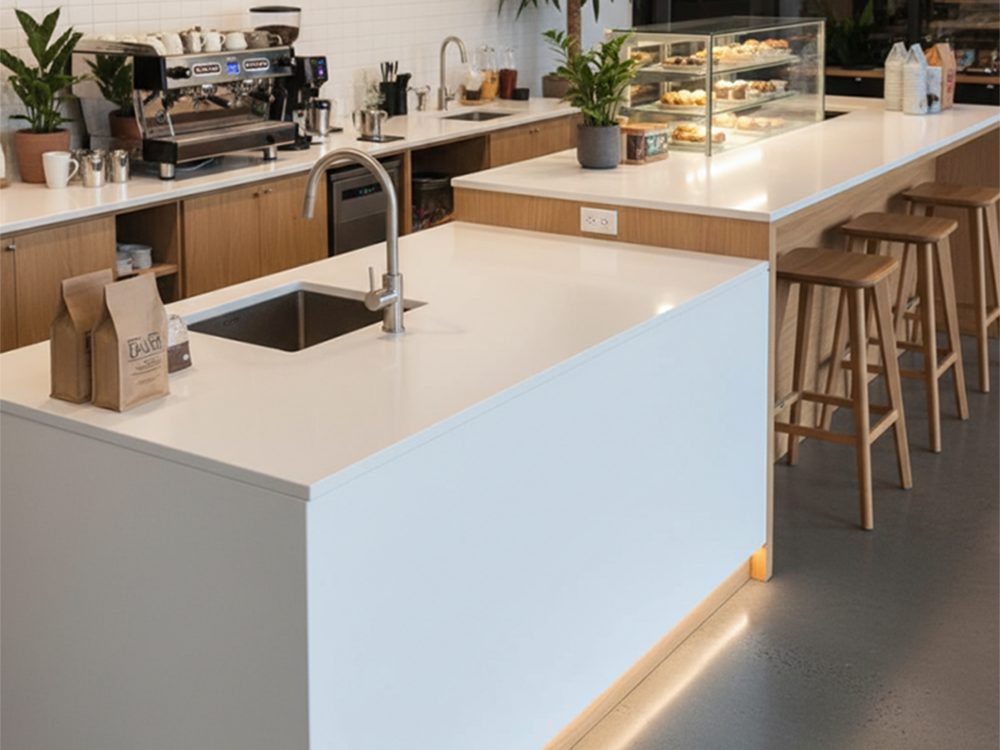
One of the most recognized advantages of acrylic solid surface is its ability to create visually seamless joints when compatible materials and suitable fabrication techniques are used.
This is particularly valuable for:
- Kitchen countertops and islands
- Long countertop runs
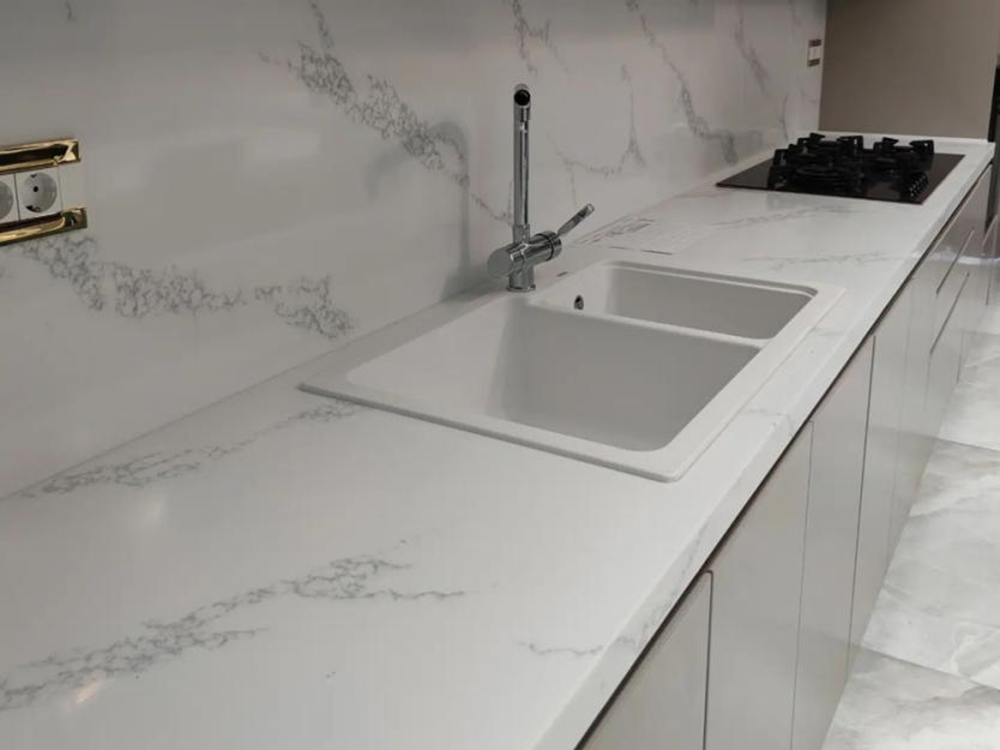
- Countertops with integrated sinks
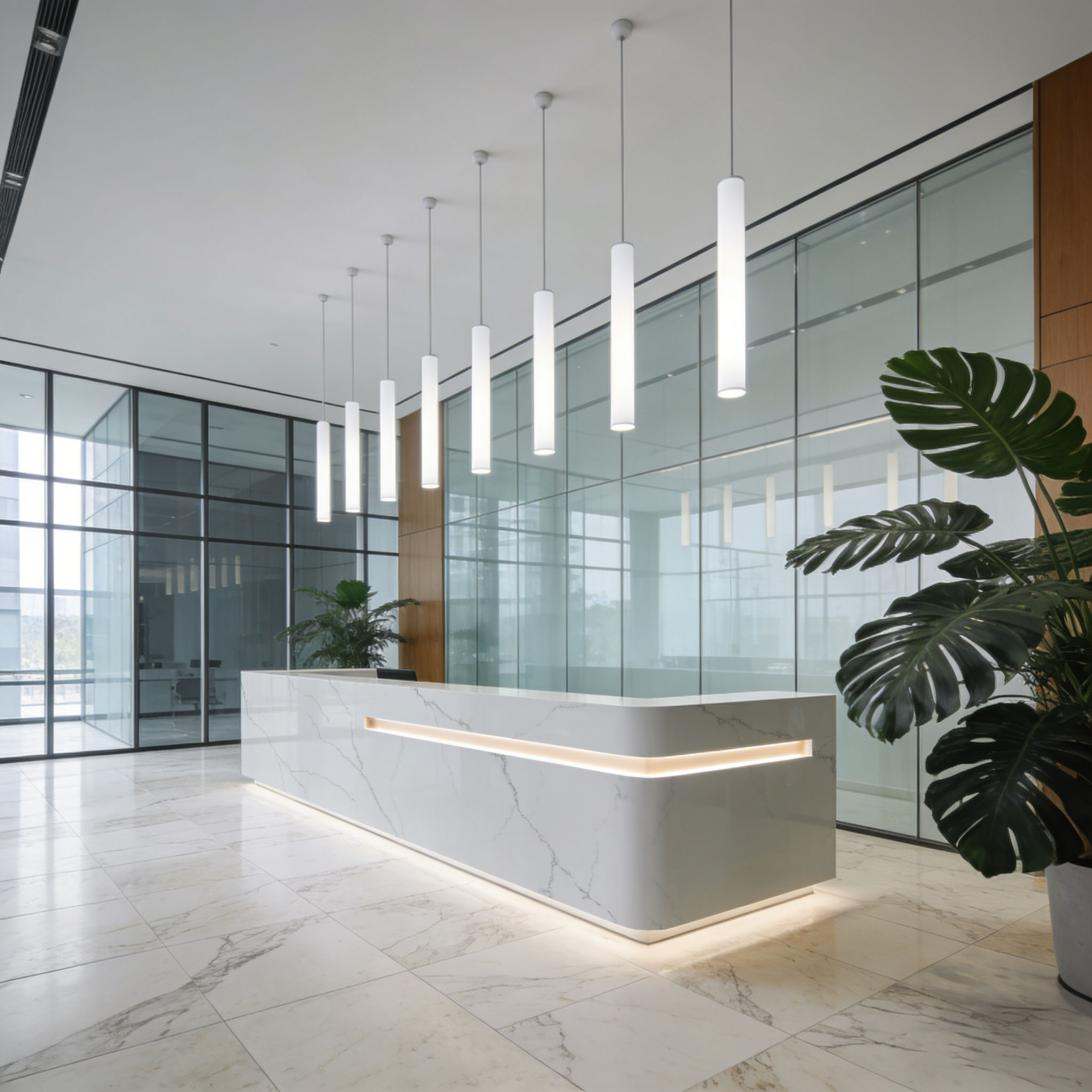
- Reception desks and custom furniture
- Commercial interior surfaces
A seamless-looking design can create a clean, continuous appearance that is difficult to achieve with materials relying on visible grout lines or conventional mechanical joints.
4.2 Thermoforming and Design Flexibility
Many acrylic solid surface products can be heated and formed into curves and customized shapes using appropriate processing methods.
This capability opens up design possibilities for rounded countertop edges, curved islands, sculptural furniture, integrated basins, and distinctive commercial interiors.
For designers and fabricators, thermoforming can help turn a flat surface material into a more expressive architectural element.
4.3 Repairability and Surface Renewal
Depending on the product and the extent of the damage, acrylic solid surface can often be sanded, refinished, or repaired by trained professionals.
This can help restore the appearance of certain scratched or worn surfaces and may reduce the need for complete replacement in some situations.
Repairability is especially relevant to hospitality, healthcare, retail, and other commercial environments where surfaces receive frequent use.
4.4 Integrated Sink and Countertop Solutions
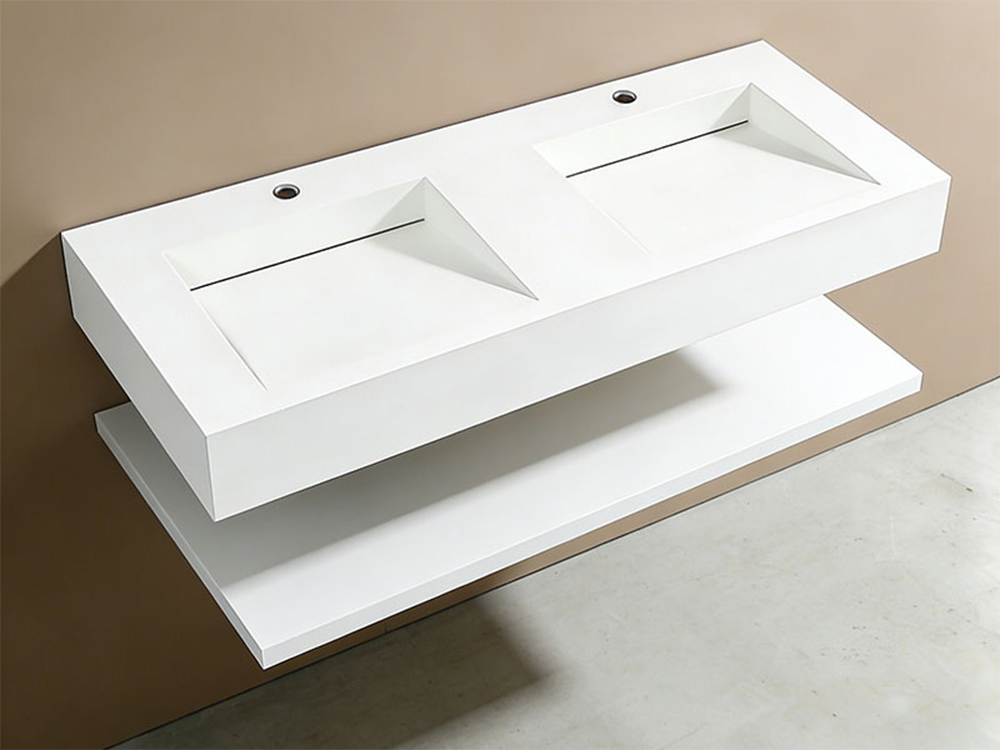
Acrylic solid surface can be used to create coordinated countertop and sink designs. When compatible components and appropriate fabrication methods are used, joints can be made visually seamless.
This is useful for kitchen islands, bathroom vanities, healthcare counters, and other applications where a continuous design is desired.
4.5 Broad Color and Pattern Possibilities
Acrylic solid surface is available in a variety of colors and visual effects, depending on the manufacturer's product range.
Options may include pure white, solid colors, fine particles, terrazzo-inspired patterns, marble-inspired designs, and other decorative finishes.
For distributors and brand owners, this range creates opportunities to build coordinated collections for different customer segments and interior design styles.
4.6 A Different Fabrication Risk Profile
For products verified to contain no crystalline silica, the material does not introduce crystalline silica from its own composition during ordinary fabrication.
This can be a meaningful advantage when comparing it with high-silica engineered quartz. However, fabrication is not automatically hazard-free. Cutting and sanding may still generate dust from mineral fillers and other ingredients, and resin-related hazards may also need to be assessed.
Fabricators should follow the product's safety data sheet, use appropriate dust extraction and ventilation, and comply with all applicable workplace health and safety requirements.
5. Quartz vs. Acrylic Solid Surface: What Should Buyers Consider?
|
Comparison factor |
Engineered quartz |
Acrylic solid surface |
|---|---|---|
|
Appearance |
Stone-like patterns and colors |
Solid colors, particles, marble-inspired and other designs |
|
Hardness |
Generally hard and scratch-resistant |
Generally softer and more susceptible to scratching |
|
Seam appearance |
Joints may remain visible depending on design and fabrication |
Visually seamless joints are possible with compatible materials and skilled fabrication |
|
Thermoforming |
Conventional quartz slabs are not normally thermoformed |
Many acrylic solid surface grades can be thermoformed |
|
Repair |
Some damage may be difficult to repair invisibly |
Many surface scratches and some damage can be repaired or refinished |
|
Integrated sinks |
Depends on product and construction method |
Well suited to compatible integrated sink designs |
|
Silica considerations |
Many products contain high levels of crystalline silica |
Can be formulated without crystalline silica; composition must be verified |
|
Heat performance |
Product-specific; hot cookware can still cause damage |
Product-specific; hot cookware can also cause damage |
|
Best-fit priorities |
Hardness and stone-like appearance |
Seamless design, shaping flexibility, and repairability |
Neither material is universally superior. The best option depends on the priorities of the project, the fabrication team's capabilities, and the applicable regulations.
6. Is Acrylic Solid Surface Suitable for Kitchen Countertops?
Yes. Acrylic solid surface can be an excellent option for kitchen countertops when the selected product is designed and specified for that application.
It is particularly attractive for projects that prioritize seamless aesthetics, integrated sinks, curved forms, customized edge details, and coordinated interior design.
Nevertheless, buyers should evaluate the product's heat resistance, scratch resistance, stain resistance, chemical resistance, cleaning requirements, and installation details before making a final selection.
For everyday kitchen use, practical guidance includes using cutting boards, avoiding direct contact with hot cookware, cleaning spills promptly, and following the manufacturer's care instructions.
For commercial or high-traffic applications, it is advisable to request relevant technical data and performance testing before specifying a product.
7. Opportunities for Distributors, Fabricators, and Solid Surface Brands
Changes in countertop regulations and growing awareness of workplace health risks are creating opportunities for businesses to review their material portfolios.
For building-material distributors, acrylic solid surface can provide an additional product category for customers seeking design flexibility and alternatives to high-silica materials.
For countertop fabricators, it offers opportunities to develop integrated sinks, seamless countertops, customized furniture, and curved interior products.
For designers and architects, its fabrication possibilities can support distinctive forms and coordinated interior concepts.
For private-label brands and wholesalers, working with an experienced manufacturer can help build a consistent product range, develop market-specific colors, and establish a reliable supply chain.
The key is to select products based on verified composition, documented performance, fabrication requirements, and destination-market compliance—not simply on a general claim that one material is replacing another.
8. Partner with a Chinese Acrylic Solid Surface Manufacturer
As a Chinese manufacturer of acrylic solid surface, we understand that international buyers need more than a competitive price. They need consistent product quality, dependable supply, a suitable range of colors and patterns, and technical information that supports their local markets.
Our product development and manufacturing capabilities can support customers looking for solid surface materials for kitchen countertops, bathroom vanities, integrated sinks, reception desks, furniture, and other interior applications.
Whether you are a building-material distributor, countertop fabricator, importer, wholesaler, or private-label brand owner, we welcome inquiries about product specifications, color options, samples, and bulk purchasing requirements.
Looking for an alternative to conventional quartz countertops?
Explore acrylic solid surface and discover new possibilities for seamless design, customized fabrication, and modern interior applications.
Contact our team to request product information, samples, or a bulk quotation.
Important note: Product composition and performance vary by manufacturer and grade. Buyers should verify crystalline silica content, technical specifications, and regulatory compliance for the destination market before purchase.